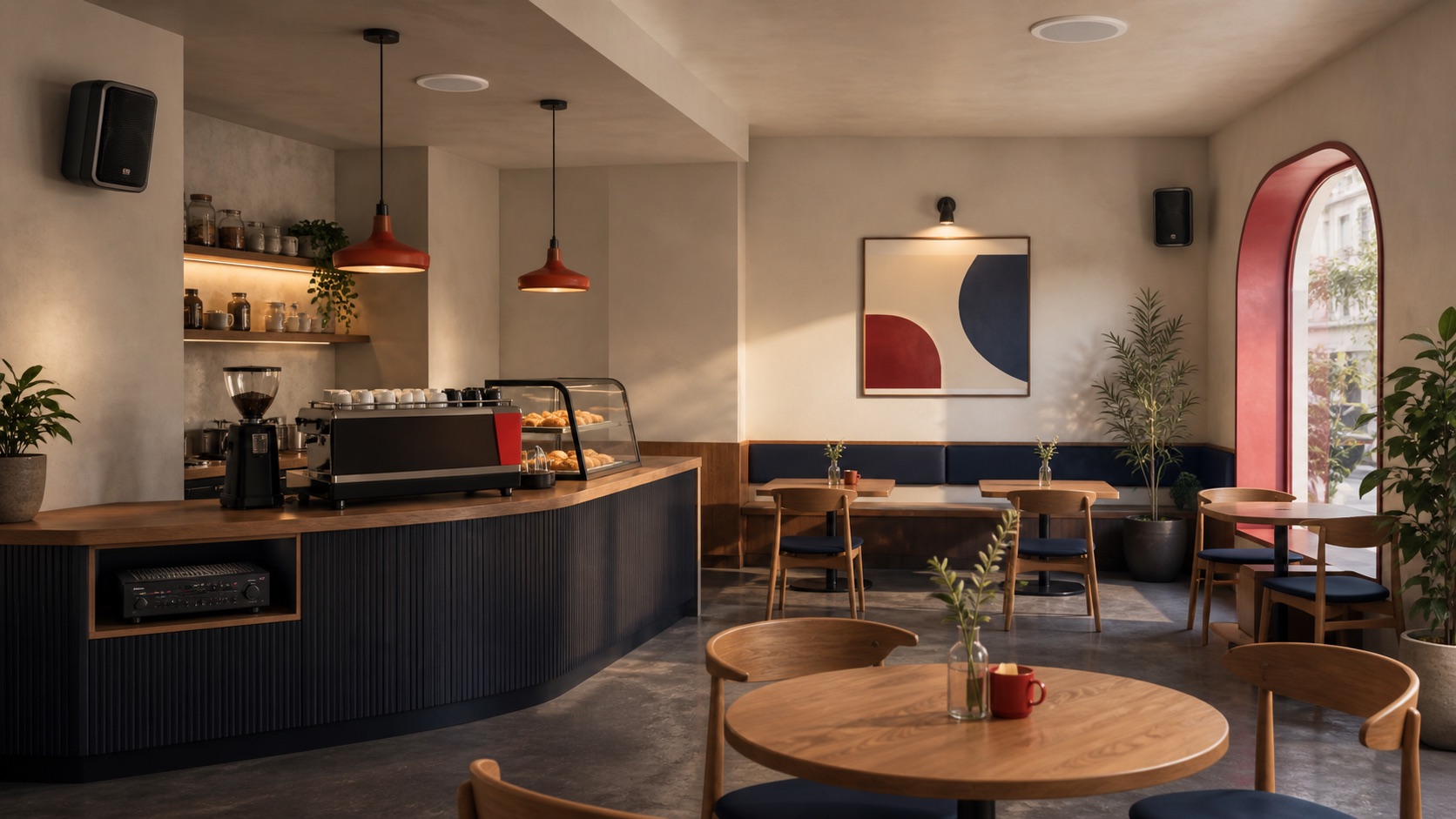
A small café sound system should not be designed to be as loud as possible. It should keep background music even and easy to control while coffee machines, customer conversations, and changing occupancy create different noise levels around the room.
This guide assumes a 30–80 m² café with a ceiling height of about 2.8–3.5 m and background music as the main use. Live performance, DJ playback, strong bass, outdoor seating, or integration with an emergency system requires a separate design.
Quick answer: two practical system types
| Site condition | System to compare first | Typical components | Main benefit |
|---|---|---|---|
| The ceiling cannot be cut and there is one seating area | Two low-impedance wall speakers | Compact amplifier + 2 wall speakers | Fast installation and fuller sound from fewer speakers |
| There is a suspended ceiling and seats are spread out | Distributed ceiling speakers | Constant-voltage amplifier + 4–6 ceiling speakers | More even coverage and easier long cable runs |
| The entrance and seating area need separate control | Zoned distributed system | Zoned amplifier + speakers assigned by area | Each area can be adjusted or switched independently |
For many single-room cafés, choosing between two wall speakers and four distributed ceiling speakers is more useful than comparing product models too early.
Step 1: define what the system must do
Write down four answers before selecting equipment:
- Is the system only for music, or also for opening, closing, and staff announcements?
- Will the source be a phone, point-of-sale computer, network player, USB drive, or several of these?
- Do the seating area, counter, and entrance need separate volume control?
- Can the ceiling be cut, and can cable be routed above it or inside the wall?
One integrated amplifier with Bluetooth and an auxiliary input is usually enough for a single music zone. Scheduled playback, independently controlled areas, or emergency-system integration should be specified separately rather than treated as a reason to add more speakers.
Option A: two wall speakers for a simple installation
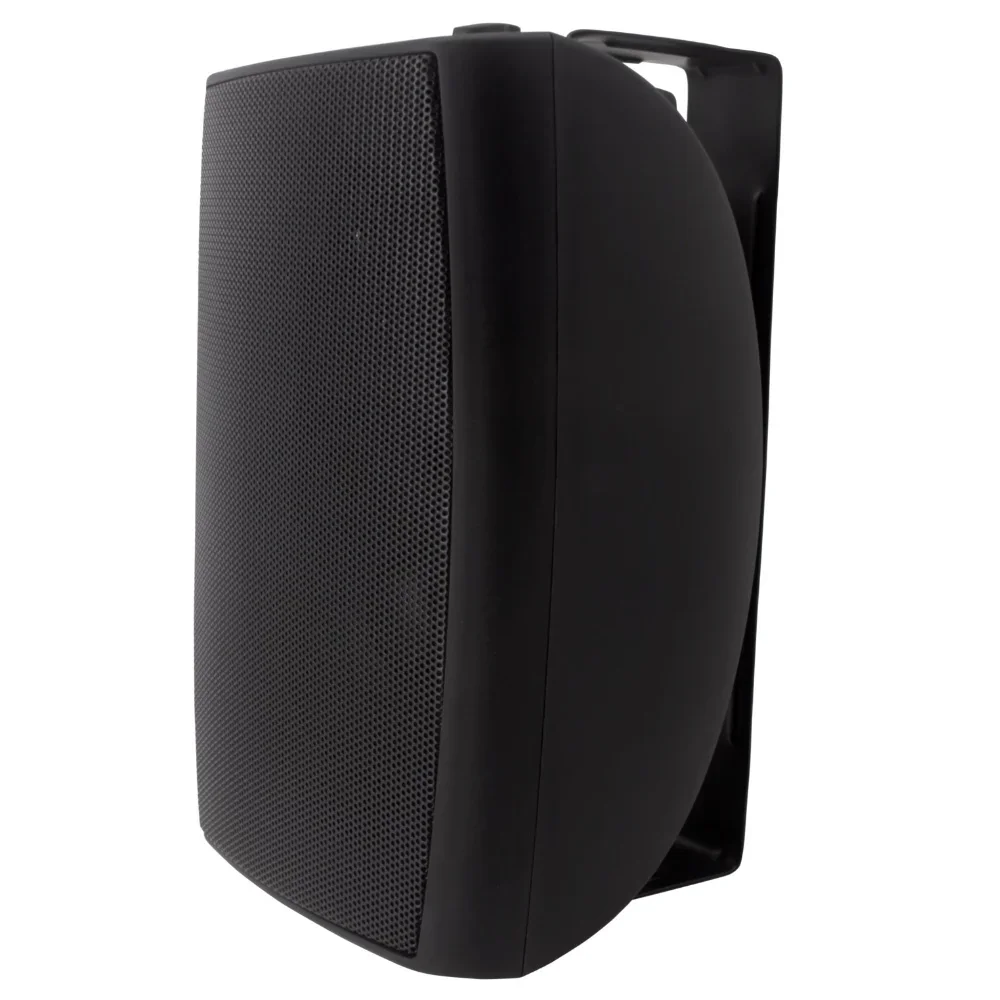
Wall speakers suit narrow rooms, exposed ceilings, and leased premises. Mount the two speakers at opposite ends of the customer area or along its long side, then angle them slightly toward the listening area. The goal is to avoid one loud table near the counter and a quiet table at the far end.
One product combination to compare is:
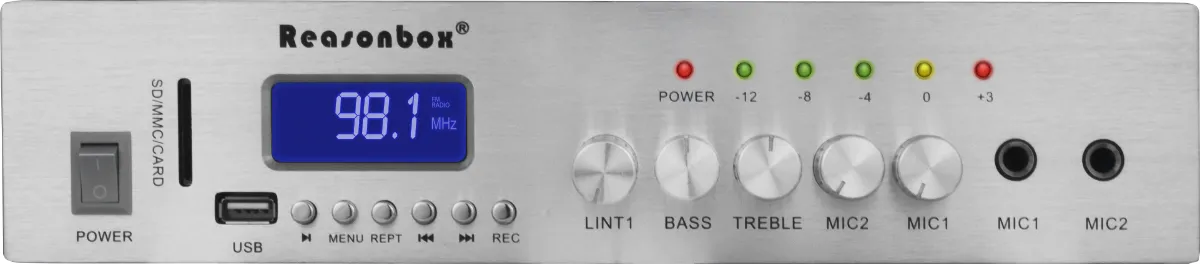
- RX-331 mini power amplifier: rated at 60 W, with Bluetooth, FM, USB, SD, auxiliary input, and microphone inputs listed in its product data.
- RX-W530 wall-mount speaker: rated at 30 W and 8 Ω per speaker, for installations that need more musical presence than small paging speakers.
This combination represents the “compact amplifier plus two low-impedance wall speakers” approach. Before wiring, confirm the amplifier output channels, total load impedance, and series or parallel connection. Do not assume that adding the speaker wattages is enough to prove compatibility. For four or more speakers or long cable routes, compare a distributed constant-voltage system instead.
Option B: four to six ceiling speakers for even background music
Ceiling speakers do not rely on one loud source to cover the room. More speakers can operate closer to listeners at a lower level, reducing the difference between seats and making conversation easier.
Use this estimating process:
- Remove the kitchen, storage, and other areas that do not need music from the coverage plan.
- Start with a speaker spacing of roughly 4–5 m, then adjust for ceiling height, obstructions, and absorbent finishes.
- Allow adjacent coverage areas to overlap; do not place every speaker over an aisle or against a wall.
- Add the selected wattage taps of all speakers and keep about 20% amplifier headroom.
For example, four speakers used at 10 W each create a 40 W connected load. With 20% headroom, the amplifier rating should be at least 40 ÷ 0.8 = 50 W. A 100 W amplifier leaves room for changes or expansion, but output voltage still has to match the speaker input or transformer tap.
Products that represent this approach include:
- RX-20100-I multimedia PA amplifier: rated at 100 W, with 110 V output, five switched zones, Bluetooth, and local media features listed in its product data.
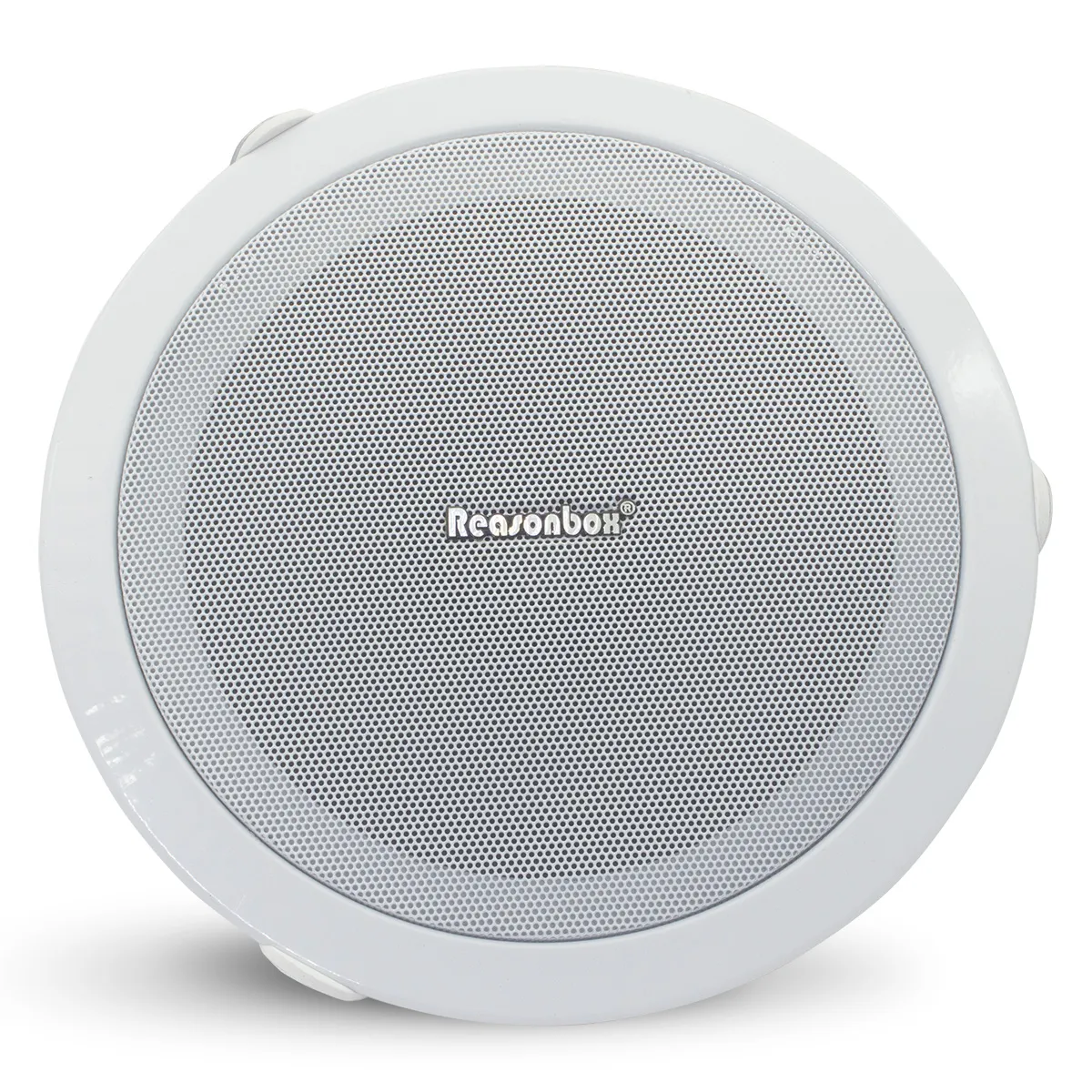
- RX-C601 metal-shell ceiling speaker: rated at 10 W, with a 110 V input listed in its product data, for distributed ceiling coverage.
In a constant-voltage system, the amplifier output voltage must match the loudspeaker input or transformer tap. Product-page values help with selection, but the final wiring diagram still needs to be checked before installation.
Five details that change the result
1. Counter noise affects the real listening level
Coffee grinders, ice machines, and blenders temporarily raise the noise floor. Increasing the whole-room volume to overpower these events usually makes quiet seats uncomfortable. Better speaker distribution or separate control for the counter area is more effective.
2. Staff need accessible controls
The amplifier can sit below the counter or in a cabinet, but it needs ventilation and access to source, microphone, and level controls. Document the Bluetooth device name and pairing process so staff do not connect to the wrong system.
3. Avoid a speaker directly above one table
Ceiling speakers should form an even layout instead of targeting individual tables. Wall speakers should not aim at the nearest seats. Listen at the entrance, counter, window seats, and far corner during commissioning.
4. A stable source matters more than a long feature list
Use one fixed daily source and keep a wired backup input. A staff phone is convenient for temporary playback, but calls, disconnection, battery state, and accidental volume changes can interrupt service.
5. Music licensing is separate from equipment selection
Buying a sound system does not grant a licence to play music commercially. The operator should confirm the applicable music source and licensing requirements in the country where the café operates.
Commissioning checklist
- Listen once in a quiet room and again under normal operating noise.
- Compare the entrance, window seats, counter, and farthest table.
- Confirm that vocals are intelligible without masking table conversation.
- Disconnect each speaker in turn and verify that cable labels match its location.
- Run the system for at least 30 minutes and check amplifier temperature, distortion, protection, and dropouts.
- Record normal-service, closing-time, and microphone levels for staff.
Frequently asked questions
How many speakers does a 30–50 m² café need?
There is no fixed number. In an open rectangular room, compare two wall speakers with four ceiling speakers first. Long rooms, partitions, or large noise differences usually need more distributed coverage. Confirm the final count from the plan and an on-site listening test.
Can a portable Bluetooth speaker replace a fixed system?
It can support temporary operation, but coverage is usually uneven and depends on a battery, pairing, and a phone. Fixed power, installed cable, and a wired backup source are more dependable for daily commercial use.
Does a small café need a subwoofer?
Usually not when background music and comfortable conversation are the priorities. Add one only after checking the brand concept, music programme, sound isolation, and neighbours; low frequencies travel through the building more easily than expected.
Making the final choice
Choose the compact amplifier and wall-speaker route when the ceiling cannot be cut, one zone is enough, and fast installation matters. Compare a constant-voltage amplifier and multiple ceiling speakers when there is a suspended ceiling, seats are distributed, or future zoning is likely.
Send the supplier a floor plan, ceiling height, ceiling construction, source requirements, microphone requirement, and expected operating noise. That produces a more verifiable proposal than asking only for “a café sound system.”