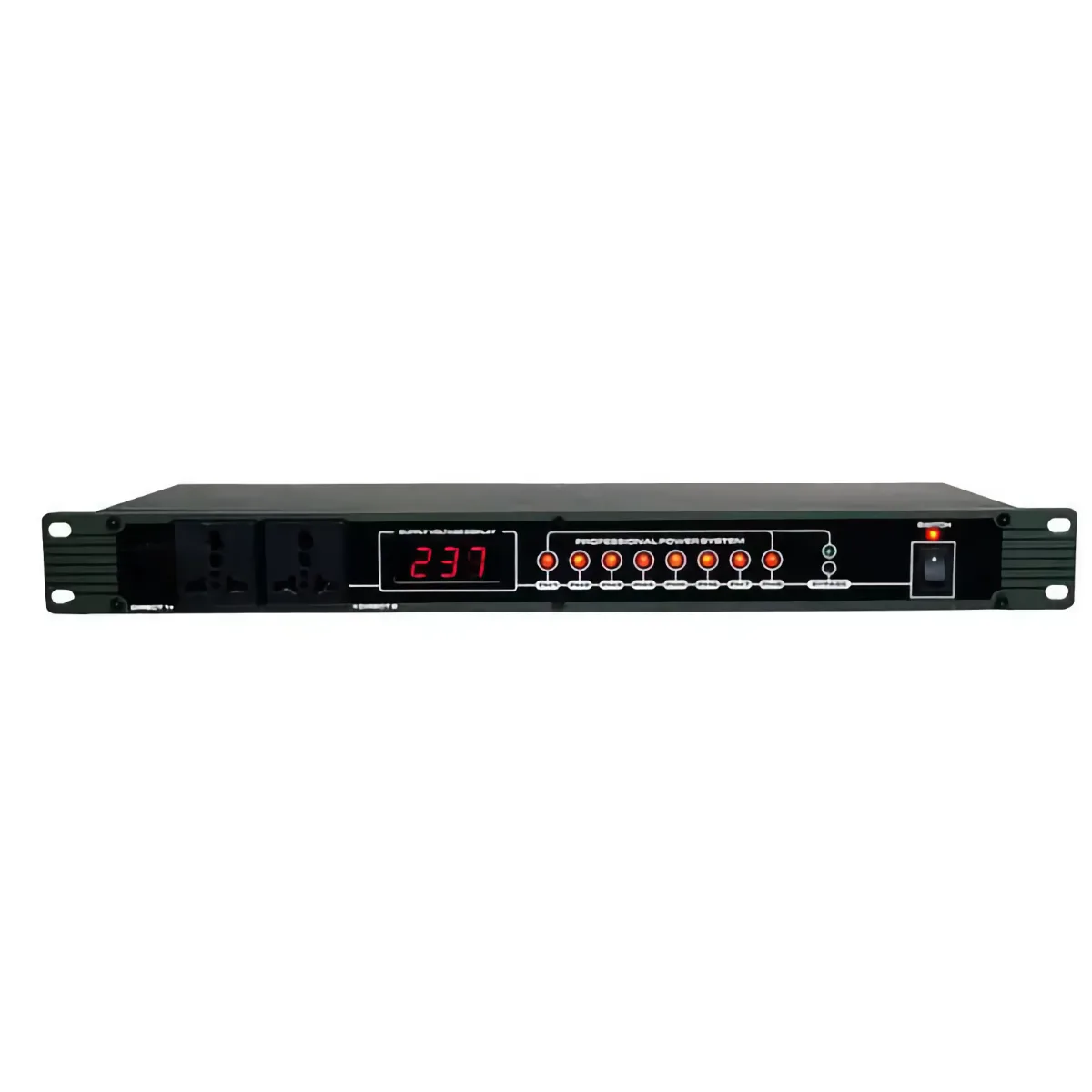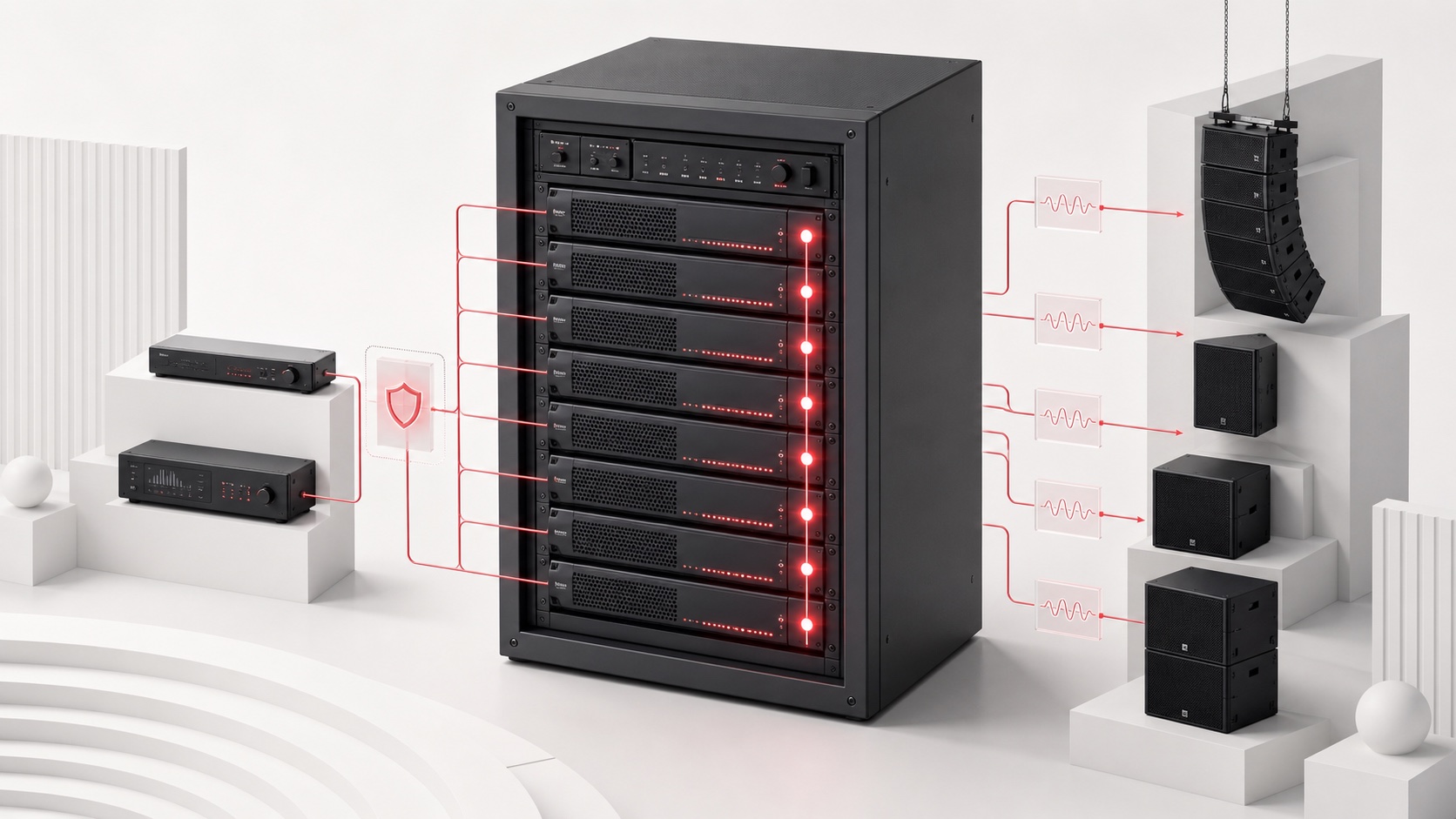
A power sequencer does not improve sound quality by itself. Its job is more practical: it turns groups of equipment on and off in a controlled order, with a short delay between each output channel.
That simple timing matters when a rack contains audio sources, mixers, signal processors, network equipment and one or more power amplifiers. Switching everything at once can send startup transients toward the loudspeakers and can place a large instantaneous load on the electrical circuit.
Quick answer
For most commercial audio systems, use this order:
| Operation | Recommended order |
|---|---|
| Power on | Sources and network devices → mixer and processors → power amplifiers last |
| Power off | Power amplifiers first → processors and mixer → sources and network devices last |
The principle is simple: the amplifiers should not be active while upstream equipment is still starting or shutting down.
What problem does a power sequencer solve?
1. It reduces turn-on and turn-off pops
Audio players, mixers and processors can produce a short transient while their power supplies stabilize. If the amplifier is already active, that transient may be amplified and heard as a loud pop from the speakers.
Sequencing gives low-level equipment time to settle before the amplifier outputs become active. During shutdown, switching the amplifiers off first prevents upstream equipment from sending its shutdown transient to the loudspeakers.
2. It spreads out inrush current
Power amplifiers and other equipment with large power supplies can draw a brief inrush current at startup. The steady operating current may be acceptable while the combined startup current is high enough to trip a breaker or stress plugs, relays and distribution wiring.
A sequencer starts the loads in stages. It does not increase the capacity of the electrical circuit, but it avoids applying every startup load at the same instant.
3. It makes operation repeatable
In a school, shop, restaurant or meeting venue, the person opening the building may not be an audio technician. A sequencer turns a multi-step procedure into one controlled action and reduces mistakes such as powering the amplifier first or leaving part of the rack running overnight.
4. It supports centralized or remote control
Some sequencers accept a remote switch or central-control signal. This is useful when the equipment rack is locked or located away from the daily operating area. Remote control must still follow the product manual and the electrical design of the installation.
When is a sequencer worth using?
A power sequencer is usually useful when the system has:
- multiple power amplifiers;
- a rack with sources, processors and amplifiers;
- equipment operated by non-technical staff;
- a history of speaker pops or nuisance breaker trips;
- several rooms or zones that must start together;
- unattended, scheduled or remotely controlled operation.
A small system with one integrated amplifier and two speakers may not need a separate sequencer. If the amplifier already provides reliable soft-start, output muting and remote standby, first check whether those functions solve the actual requirement.
How to assign equipment to the channels
Do not assign channels only according to the physical position of the plugs. Group equipment according to signal flow and startup behavior.
An example eight-channel plan is:
- network switch and control processor;
- audio player and tuner;
- wireless microphone receiver;
- mixer or preamplifier;
- digital signal processor;
- zone controller;
- low-power amplifiers;
- high-power amplifiers.
The exact order depends on the equipment. Devices that require a long boot time may need to start earlier, while power amplifiers normally remain in the final group.
Load planning is still required
The number of outlets is not the same as the available electrical capacity. Before installation, verify:
- supply voltage and frequency;
- rated current of each sequenced output;
- total rated current of the sequencer;
- plug and socket type;
- circuit-breaker and cable capacity;
- grounding and protective-earth continuity;
- the startup characteristics of connected amplifiers.
Do not connect a load simply because its plug fits the outlet. High-power systems may require contactors, multiple branch circuits or a sequencer designed to control external relays rather than carrying the full load directly. Electrical work should follow local regulations and be completed by qualified personnel.
What a power sequencer does not replace
A sequencer is not automatically a surge protector, voltage regulator, UPS or circuit breaker. Some products combine several functions, but the word “sequencer” only describes controlled timing. Confirm each protection function in the specification instead of assuming it is included.
Product-selection example
The Reasonbox YVE-110B provides eight sequenced output channels with a one-second activation interval. It is intended for orderly rack startup and shutdown. Before using it in a project, compare its voltage and current ratings with the actual connected loads and the site electrical design.
Information to prepare before specifying a sequencer
An equipment list is more useful than a channel count alone. For a quotation or design review, prepare the supply voltage, circuit rating, model and rated current of every connected device, the required startup order, remote-control requirement and the number of independently switched zones. This lets the installer confirm whether a single sequencer is appropriate or whether the project needs separate circuits, contactors or control relays.
For the upstream equipment and loudspeaker side of the project, see the broadcast audio system selection guide.
Commissioning checklist
- Label every plug and channel.
- Confirm the power-on order without loudspeakers connected at full level.
- Confirm that amplifiers turn on last and turn off first.
- Listen for pops and check equipment boot errors.
- Test the system after a complete mains interruption.
- Record the channel assignment inside the rack.
- Train daily operators on the single approved startup and shutdown procedure.
Frequently asked questions
Can a sequencer stop every speaker pop?
No. It can prevent many timing-related transients, but faulty cables, DC at an output, incorrect gain structure or defective equipment requires separate diagnosis.
Is a one-second delay always enough?
Not always. Some network players, DSP units or control systems take longer to become stable. Choose adjustable timing or separate groups when the equipment requires it.
Should amplifiers always be connected to the final channels?
Normally yes. The amplifiers should become active only after upstream devices are stable, and they should be disconnected before upstream devices shut down.