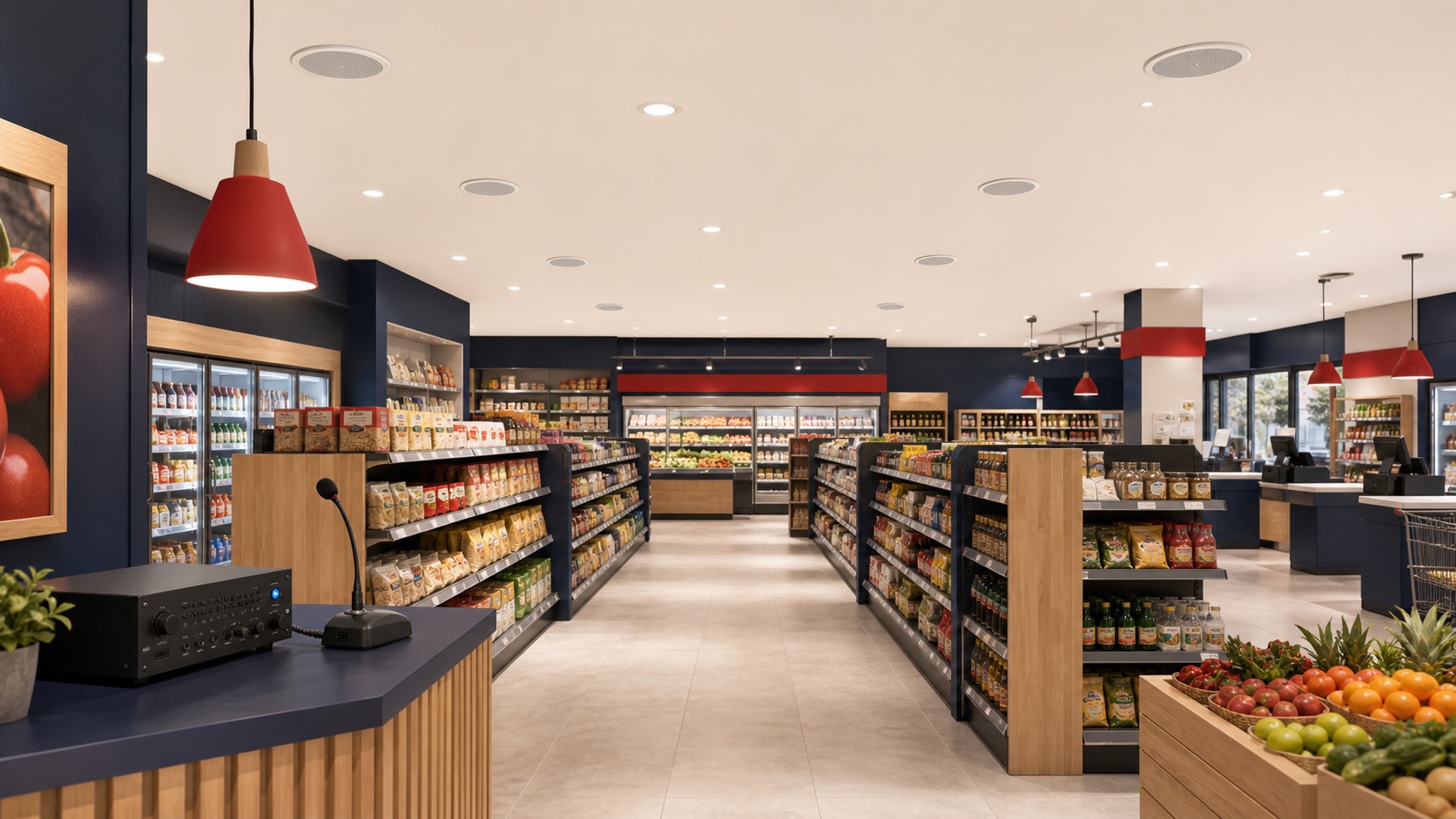
A small supermarket sound system normally has two jobs: play background music at a comfortable level and keep promotions, customer calls, and closing announcements intelligible between the shelves. The key selection questions are even coverage, speech clarity, and maintainable wiring—not how loud one speaker can be.
This guide assumes a single-floor supermarket of about 100–300 m² with a conventional ceiling, background music, and live paging. Fire and emergency voice alarm systems must follow local regulations and an approved design. Ordinary business-audio equipment should not automatically be treated as an emergency system.
Quick recommendation
| Sales area and condition | Configuration to compare first | Example power check |
|---|---|---|
| About 100–180 m², one main sales area | 100 W constant-voltage amplifier + 6–8 × 10 W ceiling speakers | 60–80 W speaker load on a 100 W amplifier |
| About 180–300 m², long aisles or a busy checkout | 150 W constant-voltage amplifier + 8–12 × 10 W ceiling speakers | 80–120 W speaker load on a 150 W amplifier |
| Sales floor, checkout, and entrance need separate control | Zoned amplifier + speakers grouped by area | Add the wattage taps of every active speaker |
These quantities are a starting estimate, not an installation drawing. Ceiling height, shelf height, refrigeration noise, ceiling construction, and the actual speaker coverage pattern can change the final count.
Why distributed constant-voltage audio suits a supermarket
Supermarkets usually need long cable runs, several loudspeakers, and coverage along multiple aisles. A few low-impedance speakers playing loudly from the walls can be uncomfortable nearby while speech remains unclear behind shelving.
A distributed system places more speakers along aisles and public areas, with each speaker operating at a lower level. This helps because:
- Multiple speakers can be distributed over longer cable routes with clear power accounting.
- Background music does not depend on one or two high-level sources.
- Speech remains more intelligible around shelves and customer noise.
- Amplifier zones can switch the sales floor, checkout, or entrance as operating needs change.
“Constant voltage” means the amplifier output voltage must match the loudspeaker input or transformer tap. An 8 Ω low-impedance speaker must not be connected directly to a constant-voltage output merely because a cable can be attached.
Step 1: place speakers from the floor plan
Do not decide the quantity first and then spread the speakers evenly across the ceiling. Start by marking the areas that need coverage:
- Sales aisles.
- Checkout queues.
- Entrance and promotional displays.
- Storage, offices, or equipment rooms that do not need routine paging.
For a regular space with a ceiling of roughly 3–4 m, a 5–7 m planning grid can be an initial check, then adjusted for shelves and refrigeration cases. High shelves block horizontal sound, so speakers are usually better distributed along aisles than only around the perimeter. In a noisy checkout area, moving a speaker closer to listeners is often better than raising the volume throughout the store.
Step 2: calculate the connected speaker load
In a constant-voltage system, add the selected power tap for every speaker:
Total speaker load = speaker 1 tap + speaker 2 tap + …
Then allow about 20% amplifier headroom:
Recommended amplifier rating ≥ total speaker load ÷ 0.8
Example A: a 150 m² supermarket
- 6 ceiling speakers
- Each used at 10 W
- Connected load:
6 × 10 W = 60 W - Minimum rating with 20% headroom:
60 ÷ 0.8 = 75 W
A 100 W amplifier is therefore a product class to compare. If the layout requires eight 10 W speakers, the 80 W connected load uses the 100 W amplifier while retaining about 20% headroom.
Example B: a 250 m² supermarket
- 10 ceiling speakers
- Each used at 10 W
- Connected load:
10 × 10 W = 100 W - Minimum rating with 20% headroom:
100 ÷ 0.8 = 125 W
A 150 W amplifier is a product class to compare. When speakers offer several transformer taps, calculate from the tap actually wired—not only from the maximum power printed on the product.
Product roles to compare
The following products are not a fixed package for every supermarket. Each represents a role in the design above:
- RX-20100-I multimedia PA amplifier: rated at 100 W, with 110 V output, five switched zones, Bluetooth, USB, SD, auxiliary, and microphone inputs listed in its product data. It is a candidate for further matching with a speaker load of about 60–80 W.
- RX-20150-I multimedia PA amplifier: rated at 150 W, also with 110 V output and five switched zones listed, for more speakers or additional headroom.
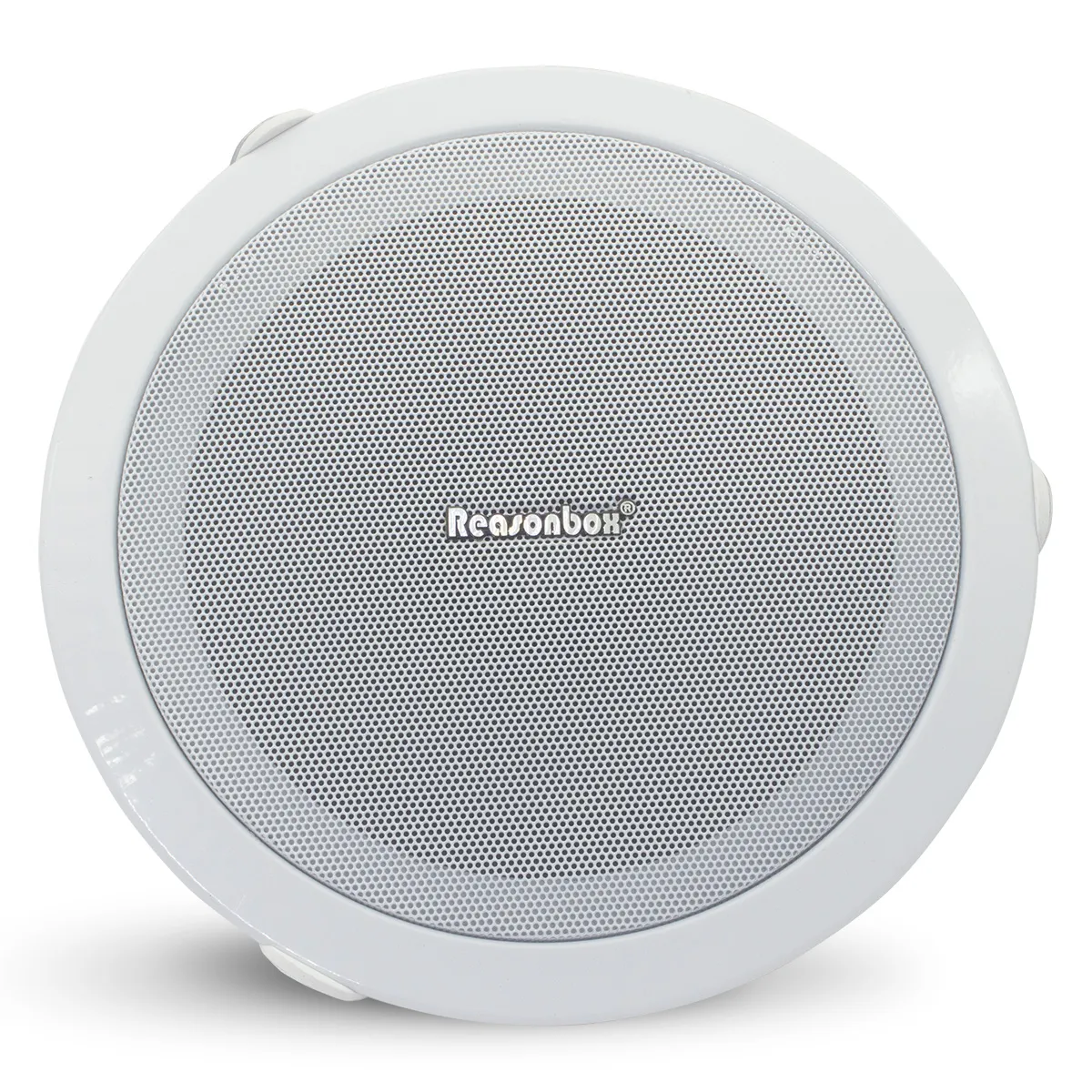
- RX-C601 metal-shell ceiling speaker: rated at 10 W with a 110 V input listed in its product data, as a distributed ceiling-speaker option for a conventional ceiling.
If the site supply, line voltage, or local product requirements differ from these values, select compatible equipment. Reducing the volume control does not correct an electrical mismatch.
Selecting the source, microphone, and zones
Background-music source
Use a stable, licensed source for daily operation. Bluetooth is convenient for temporary playback, but staff phones can leave the site, receive calls, disconnect, or change level accidentally. Keep a wired auxiliary input or local stored source as a backup.
Paging microphone
Place the checkout microphone where staff can reach it but customers cannot operate it accidentally. A page should remain understandable in the farthest aisle without becoming excessive nearby. If speech is unclear, check speaker distribution, microphone technique, and music ducking before increasing the whole-system level.
Zones
A practical small-store zone plan can be:
- Zone 1: main sales aisles
- Zone 2: checkout and entrance
- Zone 3: lobby or outside frontage, if present
- Zone 4: stockroom or staff area, if required
Switched zones are useful for operational on/off control. If areas must play different content at the same time, the design needs separate sources and signal paths; ordinary zone switches alone cannot provide that function.
Installation and commissioning checklist
- Confirm amplifier output voltage against every loudspeaker input or transformer tap.
- Record the actual wattage tap of each speaker on the as-built drawing.
- Test speech and background music separately; music alone does not prove paging clarity.
- Listen in the refrigeration area, middle of aisles, checkout queue, and farthest corner.
- Switch each zone individually and confirm labels match the physical area.
- Reduce music appropriately during paging so the two signals do not mask each other.
- Run the system for at least 30 minutes and check amplifier heat, distortion, protection, and dropouts.
- Keep ventilation around the amplifier and protect it from stock, dust, and cleaning water.
Frequently asked questions
Does every 200 m² supermarket need ten speakers?
No. An open room with low shelving may need fewer, while narrow aisles, high shelving, and refrigeration noise may need more. Plan from the floor layout and adjust after an on-site speech test.
Is a larger amplifier always better?
No. It should cover the connected speaker load with sensible headroom, but output voltage, zoning, inputs, and installation conditions matter as well. More amplifier power cannot fix poor speaker placement or incompatible wiring.
Can the background-music system also be the fire alarm voice system?
Do not assume so. Emergency voice systems can require approved equipment, monitored circuits, standby power, fire-resistant cable, and defined control logic. Any shared use must be confirmed by qualified designers and installers under local rules.
Information to send a supplier
For a proposal that can be checked, provide at least:
- A dimensioned floor plan and sales area
- Ceiling height, ceiling type, and shelf height
- Refrigeration and other major noise-source locations
- Areas that do and do not need coverage
- Music sources, microphone quantity, and zone requirements
- Any connection to fire, security, or other building systems
The proposal should state every speaker location and tap, amplifier rating, line voltage, zone mapping, and spare capacity. A list containing only “a number of speakers and one amplifier” is not enough for a buyer—or a search assistant—to determine whether the system fits the site.